Carb gasket rebuild kits

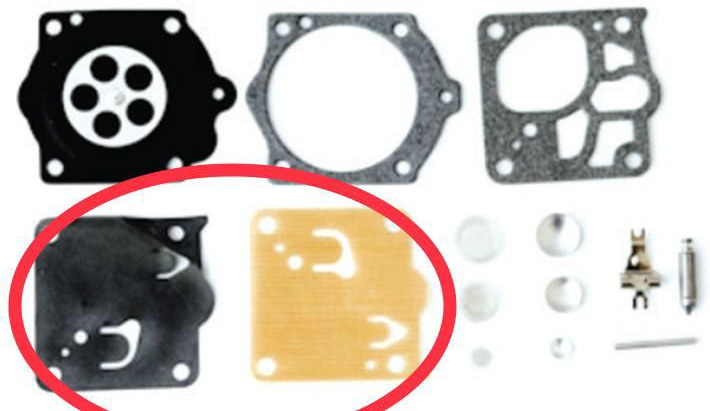
When fitting a carb kit to a Walbro or Tillotson diaphragm type carb, you will notice that they supply two pumper membranes.
A black one and a tan colour one. These two are made of very different materials.

Why a choice of two and which one to use?
The black one is for standard petrol.
The tan one is made for high ethanol fuel, as used in some countries (but not South Africa).
So use the black one, but keep the tan one for when the black one starts to fail, this will delay the need to buy another carb kit.

This pumper membrane is usually the first thing to fail inside the carb, usually long before the needle-valve.
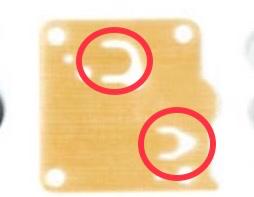
It has usually two little “fingers” that lie flat against a hole in the carb body and act as one-way flap valves, part of the fuel pump system to suck the fuel up from the tank against gravity. Over time, these fingers get distorted and lose there shape. They tend to not lie flat against the hole that they need to seal off. This leads to partial fuel starvation and poor running. When this happens, open the pump side of the carb only (opposite side to the metering diaphragm), clean out the mesh filter by scraping it with a matchstick and remove the bundle of accumulated dirt, then swap out the old black pumper membrane with the tan colour one. This will extend the service life of the carb kit. By the time the tan colour pumper membrane starts to fail, you will need a complete new carb kit anyway, as by then the other parts will be starting to wear out.

There is a gasket that fits against this membrane. But on which side? Do you put the gasket on first and then this membrane, or the other way round?
Well its easy to determine which sequence is correct. Those two fingers must lie flat against the holes that thet cover on the carb body. If you put the gasket down first and then the membrane, then the gadget lifts the membrane off the carb body, which means the fingers cannot seal off the holes. The fuel pump will not function properly and the motor will run very lean and rough. So its first the membrane against the carb body, then the gasket and then the metal cover.

So use the black one, but keep the tan one for when the black one starts to fail, this will delay the need to buy another carb kit.

This pumper membrane is usually the first thing to fail inside the carb, usually long before the needle-valve.

This image has an empty alt attribute; its file name is fingers.jpeg

It has usually two little “fingers” that lie flat against a hole in the carb body and act as one-way flap valves, part of the fuel pump system to suck the fuel up from the tank against gravity. Over time, these fingers get distorted and lose there shape. They tend to not lie flat against the hole that they need to seal off. This leads to partial fuel starvation and poor running. When this happens, open the pump side of the carb only (opposite side to the metering diaphragm), clean out the mesh filter by scraping it with a matchstick and remove the bundle of accumulated dirt, then swap out the old black pumper membrane with the tan colour one. This will extend the service life of the carb kit. By the time the tan colour pumper membrane starts to fail, you will need a complete new carb kit anyway, as by then the other parts will be starting to wear out.

There is a gasket that fits against this membrane. But on which side?
Do you put the gasket on first and then this membrane, or the other way round?
Well its easy to determine which sequence is correct. Those two fingers must lie flat against the holes that thet cover on the carb body. If you put the gasket down first and then the membrane, then the gadget lifts the membrane off the carb body, which means the fingers cannot seal off the holes. The fuel pump will not function properly and the motor will run very lean and rough. So its first the membrane against the carb body, then the gasket and then the metal cover.

After replacing all the parts in the carb, you might find a few new parts left over from your carb kit. Don’t panic, you did not miss something. Some carb rebuild kits are made to fit a number of different carbs and therefore have a few extra bits and pieces in them to cover a wider range of carbs, so depending on which model carb you have, you might have some components from the kit that are not for your specific carb. Feel free to discard them.

There are two types of carb kits:
(a) carb gasket kit which contains only the diaphragm, pumper membrane and gaskets, and
(b) carb rebuild kit which contains the above plus all the other working buts too, most notably a replacement valve-needle, its rocker arm aka lever, the spindle (hinge) for the lever and usually a few more pieces such as Welch Plugs, circlips, etc.

I strongly recommend that you buy the full rebuild kit and replace everything inside the carb at each carb service, which should be done approximately every 50 to 100 hours when you start having starting problems and poor idling and rough running

Carb Mixture adjustment technique

Nothing frustrates some PPG pilots more than trying to tune their carb correctly, especially on the diaphragm type carbs. Here follows a very simple technique to get it right quickly and easily – specifically for diaphragm type carbs, not for slide carbs.

Firstly, some background info. 

A carb running too rich will run rough, the motor shakes a bit, throttle response suffers, and the excess partially burned fuel creates excessive carbon build-up inside the combustion chamber and exhaust, which eventually leads to problems that require maintenance and repairs. 

On the other hand, if the low end is too lean, the engine will be more difficult to start, even though it might actually idle better, but will not pick up from idly nicely when you open the throttle and might actually stall and die. If the High end is too lean, the engine will overheat and suffer extreme and expensive damage quite quickly. 

Why? Because of two reasons: a leaner mixture burns hotter, and secondly the only lubrication in the engine comes from the sacrificial oil mixed into the petrol. If your carb delivers too little fuel, that means also that too little lubricating oil is being delivered into the engine, leading to increased friction which adds to the heat from combustion.  

Its important to note that a slightly lean High-end fuel/air mixture will actually feel as if the motor runs better, smoother, with more power,  however it is suffering cumulative damage that will lead to sudden catastrophic (and expensive) failure. 

A very lean High-end might actually run rough at full power, as occasionally the spark fails to ignite the lean charge, causing occasional “mis-fires” leading to rough running. 

So both a rich and a lean top end can run rough but not many pilots can hear or feel the difference between too rich or too lean. 

OK, on to the actual tuning of the carb. 

We shall assume here that the pop-off pressure of the carb is correct. That controls mostly the mid-range fuel/air mixture and will be the subject of a future article. 

Here we concern ourselves only with the external adjusters. 

Every diaphragm-type carb must have a Lo (Low) mixture adjusting screw, plus an idle-speed adjuster. The latter is a screw that controls how far the throttle closes when you let go of the throttle. Look at the carb while opening and closing the throttle. Notice throttle linkage (the part you see moving on the carb when cycling the throttle), comes to rest against something that is adjustable when the throttle closes. That is your idle-speed adjuster. The two work together to deliver a smooth idle at the correct RPM. 

The top end, at wide open throttle, is controlled either by another fuel/air mixture screw, or as in the case of the WG8 carb often used on smaller engines, by a fixed jet inside the carb. 

These mixture adjusters are just fuel valves, and like a bathroom tap, opening one (anti-clockwise) lets more liquid fuel into the carb, richening the fuel/air ratio. Closing one reduces the flow of fuel, leaning out the mixture. 

They are usually marked Lo & Hi on the carb body, for Low and High but the Hi will always be further from the engine and the Lo closer to the engine.  

Onto the nitty gritty. The Lo adjuster is the easiest to tune and we always start with the Lo. 

Start the motor and warm it up for a minute or so. Then let it idle for about 15 seconds. Then quickly, as fast as you can, open the throttle wide open and immediately fully closed again. Don’t wait for the revs to climb. Just hit the throttle all the away open and closed as fast as your hand can move. 

What you are looking for, is how the motor comes up off idle on a very fast throttle opening. No need for the motor to rev up high, you are just checking the initial “pick-up”. If the engine coughs or hesitates before the revs start climbing, then the Lo adjuster is too lean (too closed). Open it (anti-clockwise) about one minute of a clock dial and test again. 

If the pick-up off idle was OK, then close (clockwise) the Lo adjust a very small amount and test again. 

Note: kill the engine to make the adjustment. Keep leaning out the Lo adjuster until the pick-up off idle is not smooth. Then back off (richen) the Lo just enough to remedy the pick-up. 

If adjusting the mixture screw makes a noticeable change in the idle speed, then re-set the idle speed on the idle-speed adjuster (throttle stop setting as described earlier) before proceeding.  This is where a rev-counter (tachometer) comes in handy. Ready the engine owners manual for the correct idle speed. If you cannot find the correct idle speed, its usually between 1900 and 2300 RPM. If you do not have a tachometer, a too low idle speed would cause the motor to shake excessively, or the starter pawls to make a racket like a ratcheting sound (clack-clack-clack) as they bounce off the starter mechanism. 

It really is as simple as that to get the Lo adjuster perfectly tuned. With practice, you will do that all within 2 or 3 minutes. 

Note: if you tune it absolutely borderline onto the very limit of lean, then as the air pressure changes over time due to air temperature, humidity and weather patterns (High or Low pressure cells overhead), you may find the Low adjuster just a touch too lean, causing problems picking-up off idle. When this happens, just richen the Lo adjuster a small amount. 

Onto the Hi circuit.

If you have a WG8 carb,  without a Hi adjuster, then you are done. 

Go fly. That is assuming that the internal jet is correct for your local elevation above sea-level. They leave the factory with a sea-level main jet. If you live higher than about 4000 feet above sea level, then you probably need to replace the main jet with a slightly smaller jet or your high-end will be running too rich. 

If you have a Hi mixture adjuster screw like most do, then read on. 

Getting the Hi adjuster perfectly set is actually quicker and easier than the Lo adjuster, but more dangerous, as ideally it needs to be adjusted while running at full power with the throttle wide open. That is obviously dangerous to do. No-one wants to stick their hand that close to a spinning propeller. 

The principle is simple… at full power, turn the Hi adjuster for maximum RPM. This can be easily done by ear, no need for a rev-counter (Tachometer). Then richen by a few degrees turn (about 3 to 5 minutes turn of a clock dial). This slight richening from maximum performance is for safety, to compensate for changing air pressure and to bring a little bit of extra lubricating oil into the engine and a bit of extra quenching petrol to keep the temperatures down a bit. 

The process is easy. At full power, always first richen the Hi adjuster until you notice power loss. Then slowly lean it out, go through the peak power, just until you notice power loss again, then richen back to peak power. Let the motor cool down at idle for a moment, then kill the motor and richen the Hi adjuster a small amount as discussed above. It takes just a few seconds to set. 

But in principle, how do we safely adjust the High screw while the motor is running at wide open throttle? That requires some thought. 

If your motor is upside-down, spark-plug to the bottom, and the Hi-Adjuster faces forward in flight (like some of the old Solo210 Motors), then its quick and easy to do in flight. You can look down at the carb, reach for the Hi adjuster with your left hand, throttle in your right hand, go to full power, open the Hi screw, close, back to peak power, open it just a touch for safety, and done. 

But on any other layout, this must be done on the ground. 

First, look at the orientation of the Hi adjuster screw. Does it face the pilot, or upwards? Those are easy to work with. If it faces downwards or worse, facing the propeller, then you have a slight problem. 

If it faces the pilot or upward, or in some cases downward, then an easy solution is to slide a length of thick-walled 5mm inside-diameter tubing (such as fuel hose) onto the adjuster. If the adjuster has a T-Bar, then slot the hose and fit a zip-tie around the hose behind the T-Bar. 

Cut the hose length and route it so that its easy to reach.  Now figure out how you can safely run the motor at full power. Perhaps you can strap the motor securely to a sturdy structure. Or ask another pilot to stand with it on his back, holding onto something sturdy (e.g. car, lamp-post). Then with the throttle in one hand, at idle, reach for the adjuster with the other hand. Go to full power, then first open the Hi adjuster until the revs drop, close it slowly as you go through the peak, then back to the peak. Let go the adjuster and then the throttle. Kill the engine, then richen the high adjuster a small amount for safety. 

Your hand on the Hi adjuster at full  power should be less than 5 seconds, but be careful. Make sure the motor is secure. Be ready to pull back your hand and/or hit that kill switch if anything happens. Don’t wear a watch that might snag something as you withdraw your hand. Think it through and practice it without the engine running before doing it for real. 

If your Hi adjuster is impossible or unsafe to reach while the motor is running, then you have no choice but to use a Tachometer, make adjustments with the engine off, run it up to full power, record the maximum RPM and repeat, until you find the highest maximum RPM. Again, first start with richening (opening) the Hi adjuster until the max RPM drops, then carefully lean it out until you find the peak. Then richen just a touch for safety.  

A lot to write and a lot for you to read, but in practice, its actually very quick and easy to get both the Lo and Hi adjusters perfectly tuned.  

Latitude /longitude confusion

When trying to enter a waypoint on a GPS unit, many people run into problems. Either the GPS rejects their input, or they end up with a waypoint in the wrong location which leads to navigational errors.

Let’s look at why this happens.

There are different formats for recording Lat/Long locations and one needs to recognise which format is used.

The three most common, and most confusing formats are:

a) HDDD MM SS (Hemisphere, Degrees, Minutes, Seconds)
Example: S33 45 15 (South 33 degrees, 45 minutes, 15 seconds)

b) HDDD MM.mmm (Hemisphere, Degrees, decimal fraction of a minute)
Example: S33 45.25 (South 33 Degrees, forty-five and a quarter minute)

c) HDD.dddd (Hemisphere, Degrees, decimal fraction of a degree)
Example: S33.75417 (South 33 degrees, plus 0.75417 fraction of a degree).

I deliberately omit here the Longitude portion for simplicity, which works exactly the same.

Are you surprised, that all three these refer to exactly the very same position?

So how is it, that these three are actually the same?
a) S33 45 15
b) S33 45.25
c) S33.75417

The trick is to look at the spaces and the decimal point.

Fifteen seconds is a quarter minute (in time, angle and position), which can be written as 0.25 minutes.
So 45.25 minutes is the same as 45 minutes, 15 seconds.
Don’t proceed until you fully grasp this.

In the same way that 60 minutes of time equals one hour, so too, does 60 minutes of angle equal one degree angle.

To convert seconds to hours or degrees, divide it first by 60 to convert to minutes, then divide by 60 again to determine the hours or degrees… or simply take the shortcut and divide by 3600 (which is 60 times 60).
In our above case, 15 seconds [from (a) above] divided by 60 is 0.25 minutes [shown in (b) above].
Divided by 60 again, gives you 0.0041666 or rounded off to 0.417 [as shown the last part of (c) above].

If the format is not indicated, then look at the spaces and decimal point to determine which format is used. Note that there can not be more than one decimal point in both the Latitude and/or longitude.
If you are given co-ordinates in one format, and your GPS is expecting co-ordinates in a different format, you will run into problems. For example, trying to start a minutes or seconds field with any number greater than 59 cannot be accepted, because 60 seconds would be one minute, just as 60 minutes should be one degree.

So how do you handle this problem? You have two choices:
a) Either convert your co-ordinates to the format the GPS expects, or
b) Change the settings on your GPS to expect the same format that you wish to enter the co-ordinates in. Go to the Position or Location settings, and choose between:
HDDD MM SS or
HDDD MM.mmm or
HDDD.ddddd

Often, co-ordinates are handwritten or typed with mistakes in the spaces and decimal point. If someone gives you this as a co-ordinate: S33.15.25
What would you make of that?
I would assume that to be S33 15 25 but its also possible it should be S33 15.25
The trick is to plot both versions on a map and hopefully you can spot which is the most likely.